

Vision Intel – AI Customer Service Platform
Vision Intel (Help+) | Building a Multi-Role AI-Powered Customer Support Ecosystem at Builder.ai
During my nine months at Builder.ai between Q3 2024 and Q1 2025, I served as the Senior Product Manager responsible for transforming Vision Intel (Help+), one of the most ambitious and technically complex products in the company’s portfolio.
Vision Intel set out to solve a challenge no traditional support system could handle: unify customers, merchants, manufacturers, government entities, and super admins under one intelligent platform and enhance the entire ecosystem with advanced AI assistance, AI execution, AI analytics, OCR automation, and multi-role governance.
The product was massive in scope. Five user types, hundreds of workflows, deep operational complexity, and dozens of cross-team interactions. My responsibility was to bring clarity to this complexity: define every flow, structure the entire ecosystem, write all user stories, guide the design and engineering teams, and shape the intelligence layer that would sit at the core of Vision Intel.
Across these months, I built one of the most comprehensive product architectures of my career centered around three advanced AI systems that elevated Vision Intel far beyond a conventional ticketing or support platform.
Designing the Foundation of a Multi-Role Support Ecosystem
Before building the AI layer, Vision Intel needed a strong structural backbone.
I redesigned the product experience across all five roles:
- Customers using the mobile app to submit tickets, scan documents, renew warranties, and chat with AI
- Merchants resolving customer issues, analyzing complaints, and managing their operations
- Manufacturers handling escalations and warranty problems
- Government Entities overseeing compliance and regulated service complaints
- Super Admins coordinating the entire ecosystem, permissions, analytics, and workflows
Each role had its own purpose, data views, capabilities, and responsibilities and each required its own interface, permissions structure, and user journey.
I rebuilt every part of the product into clear modules: ticketing, OCR, communications, analytics, case routing, escalation layers, SLA enforcement, and customer history. Once the ecosystem was structurally sound, I moved toward the part that would define Vision Intel’s uniqueness: its AI-powered intelligence layer.
The Three AI Systems That Powered Vision Intel
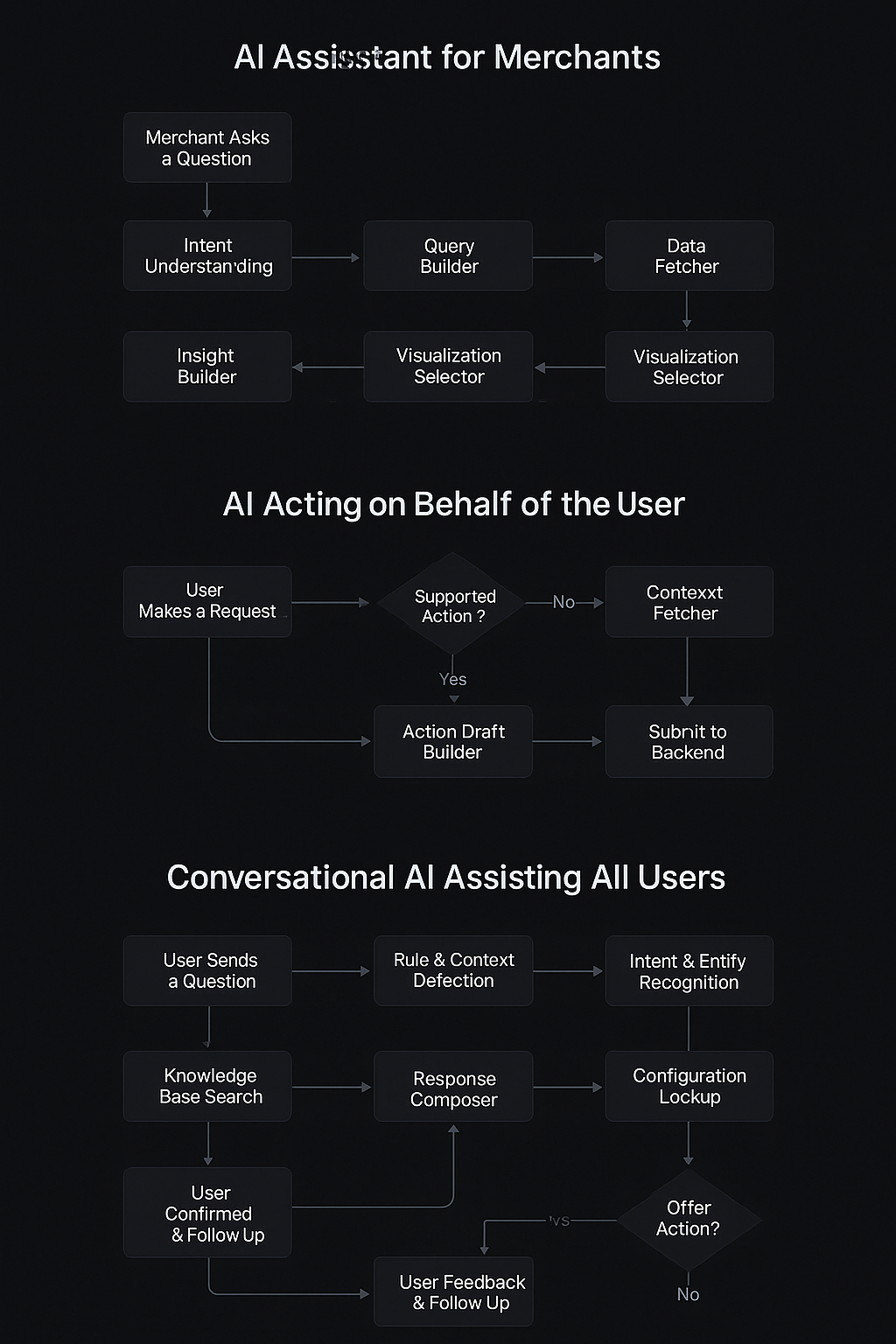
Vision Intel was not “an app with AI.”
It was a full customer-support ecosystem designed around AI.
The platform featured three major AI systems each serving a different audience and purpose. Together, they reshaped how merchants make decisions, how customers get help, and how support teams operate.
The most advanced AI in the entire ecosystem was the Merchant AI Assistant a system designed to behave like an internal data analyst capable of answering complex operational questions, generating dashboards, and transforming raw data into actionable insights.
Merchants normally struggle with navigating mountains of complaint data, service metrics, SLA performance, product breakdowns, and multi-branch activity. The AI system solved this by allowing merchants to “talk to their data.”
With a single message like:
“Show me all unresolved delivery complaints from Riyadh last week, grouped by branch.”
the AI would:
- Understand the query
- Build a structured data request
- Map it to Vision Intel’s database schema
- Retrieve the relevant information
- Generate a custom-built dashboard
- Provide a human-readable summary of insights
- Offer follow-up suggestions or deeper analysis
This created a transformative merchant experience. Instead of navigating a complex reporting interface, merchants interacted with their entire operational dataset through a single AI interface.
1. AI Assistant for Merchants: Dynamic Dashboards, Instant Reports & Data Query Engine
The most advanced AI in the entire ecosystem was the Merchant AI Assistant a system designed to behave like an internal data analyst capable of answering complex operational questions, generating dashboards, and transforming raw data into actionable insights.
Merchants normally struggle with navigating mountains of complaint data, service metrics, SLA performance, product breakdowns, and multi-branch activity. The AI system solved this by allowing merchants to “talk to their data.”
With a single message like:
“Show me all unresolved delivery complaints from Riyadh last week, grouped by branch.”
the AI would:
- Understand the query
- Build a structured data request
- Map it to Vision Intel’s database schema
- Retrieve the relevant information
- Generate a custom-built dashboard
- Provide a human-readable summary of insights
- Offer follow-up suggestions or deeper analysis
This created a transformative merchant experience. Instead of navigating a complex reporting interface, merchants interacted with their entire operational dataset through a single AI interface.
2. AI Acting on Behalf of the End User: The Action Execution Engine
This second AI system turned Vision Intel into an agent capable of performing support actions on behalf of customers.
Instead of manually filling forms or navigating menus, customers could simply tell the AI:
- “I want to file a complaint about Merchant X.”
- “Help me renew my warranty.”
- “Book a maintenance appointment for next Tuesday.”
- “I need to report a damaged product.”
The AI would:
- Detect the user’s intent
- Fetch all relevant context: user details, past tickets, linked products
- Build a draft action (ticket, appointment, renewal request, etc.)
- Present a full preview for the user to review
- Submit the action upon approval
- Track it and provide real-time follow-up through chat
This made the system radically more accessible especially for users unfamiliar with technical forms.
3. Conversational AI for All Users | Multi-Role Knowledge, Guidance & Troubleshooting
The third AI layer was the cross-ecosystem conversational assistant embedded directly in the Help+ mobile app and web dashboards.
It served every user type: customers, merchants, manufacturers, government officials, and super admins, each receiving answers tailored to their context.
The AI could:
- Answer questions based on system knowledge
- Explain rules, SLAs, warranties, and workflows
- Locate tickets, statuses, and histories
- Provide troubleshooting advice
- Guide users through next steps
- Offer relevant actions (“Would you like me to escalate this?”)
- Pull structured data from backend systems
- Route unresolved queries to human agents with all context attached
This conversational AI became the front door of Vision Intel, ensuring that every user had instant access to guidance without relying on traditional support processes.
Building the Complete Product Blueprint
Beyond AI, Vision Intel required a detailed product architecture.
I rebuilt every core module:
- Ticketing
- Escalation & routing
- OCR document processing
- User profiles
- Merchant & manufacturer dashboards
- Government entity oversight
- Notifications & SLA events
- Analytics & activity logs
- Case lifecycle management
- Permissions & multi-role governance
Every part of the product was supported by hundreds of INVEST-style user stories, each with:
- Gherkin acceptance criteria
- Positive & negative scenarios
- Edge cases
- Required inputs
- Step-by-step flows
- Arabic & English messages
- Screen-level interaction details
This made Vision Intel one of the most complete, well-documented products I managed and one of the clearest for design and engineering teams to build.
Integrating AI Into the Core Product Experience
What made Vision Intel unique was not that it had AI features, it was that AI reshaped the entire product.
AI didn’t sit on top of the experience.
It was the experience.
- Merchants gained a data analyst.
- Customers gained an action assistant.
- All users gained a conversational support interface.
- Documents were processed automatically through OCR + verification flows.
- Routing and escalation used AI signals.
- Insights were generated automatically.
The product evolved from a traditional support system into a living, intelligent ecosystem.
Impact & Legacy of the Project
During my nine months leading Vision Intel:
- I built the entire AI product architecture
- Designed all flows for five user roles
- Documented hundreds of user stories
- Connected design + engineering into one clear blueprint
- Reshaped the ticketing & support model around intelligence
- Implemented AI that could analyze, act, and communicate
- Streamlined the entire ecosystem into a cohesive experience
Vision Intel became one of the most structured, scalable, and innovative platforms within Builder.ai, a true demonstration of how AI can reinvent customer support at scale.
Building digital products that solve real problems and drive measurable impact.
Copyright © Ashraf Al Kassem


.png)